
Systems rarely operate in isolation.
They exchange information.
They hand off responsibility.
They share resources.
They depend on one another.
Every one of those interactions creates an interface.
Interfaces exist between people.
Between teams.
Between applications.
Between hardware and software.
Between organizations.
Most operational failures are not caused by individual components suddenly becoming unreliable.
They occur where reliable components interact.
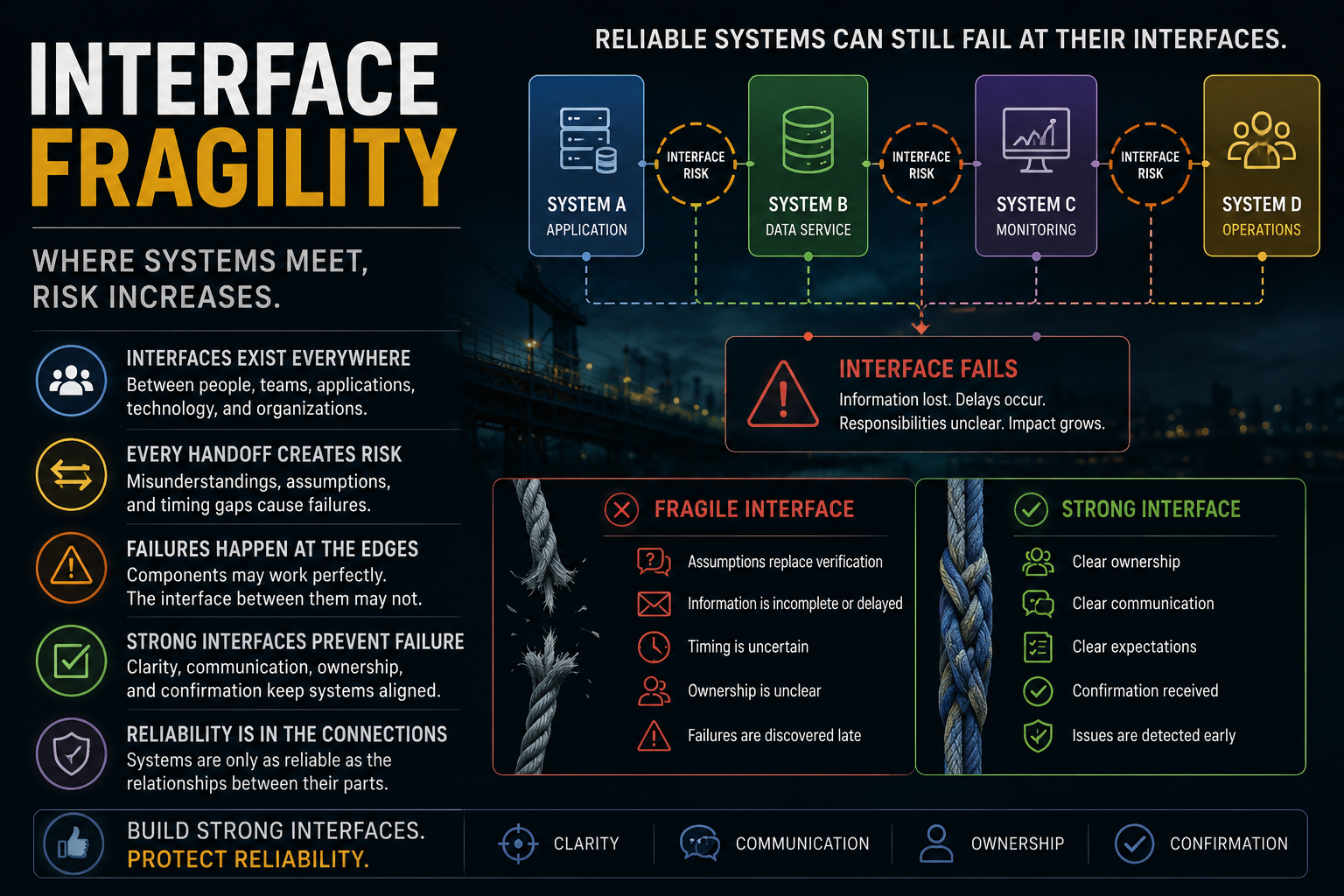
This is interface fragility.
Interface fragility describes the increased risk that exists wherever information, responsibility, or control moves from one part of a system to another.
Each handoff creates an opportunity for misunderstanding.
Assumptions replace verification.
Expectations become unclear.
Information arrives incomplete.
Timing begins to matter.
The individual systems may continue functioning exactly as designed.
The interface between them does not.
One team assumes another has acknowledged the issue.
A monitoring platform forwards an alert that never reaches the correct destination.
A process depends on information that is delayed by only a few minutes.
Each event appears minor by itself.
Together, they create operational failure.
This is why experienced operators pay close attention to transitions.
The transition between shifts.
The transition between automated and manual control.
The transition between vendors.
The transition between applications.
The transition between one operational team and another.
These moments often determine whether a small issue remains manageable or develops into something much larger.
Strong interfaces are built on clarity.
Clear ownership.
Clear communication.
Clear expectations.
Clear confirmation that information has been received and understood.
Reliable systems are not simply collections of reliable components.
They are collections of reliable relationships between those components.
When those relationships weaken, operational performance begins to decline.
The failure may not originate within any single system.
It may exist only where those systems meet.
Because reliability is not determined solely by how well individual parts perform.
It is also determined by how well they work together.