
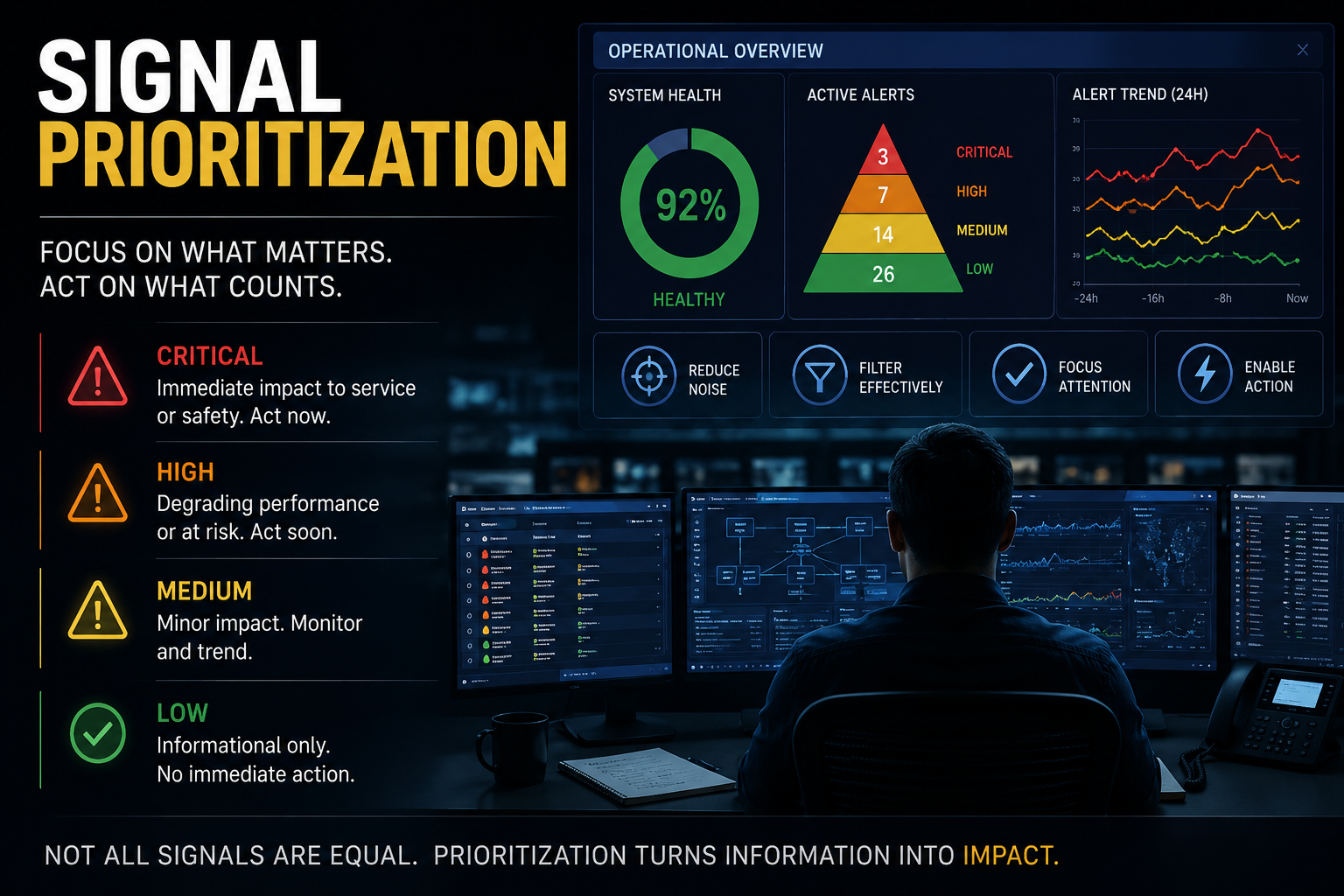
Every operational system produces signals.
Some are important.
Many are not.
Alerts.
Notifications.
Metrics.
Warnings.
Status updates.
Logs.
Dashboards.
Each one competes for attention.
The challenge is that not every signal deserves the same response.
Signal prioritization is the ability to distinguish information that requires immediate action from information that simply exists.
This sounds straightforward.
In practice, it rarely is.
Modern operational environments generate enormous amounts of data.
Monitoring platforms become more sophisticated.
Dashboards become more detailed.
Automation creates additional notifications.
Visibility continues to increase.
Attention does not.
Operators still have a finite amount of time and cognitive capacity.
When everything appears important, nothing truly stands out.
Critical warnings become buried beneath routine activity.
Meaningful trends become lost inside constant noise.
The problem is not a lack of information.
The problem is identifying which information matters most.
Experienced operators rarely react to every signal.
Instead, they evaluate context.
They recognize patterns.
They understand relationships between systems.
They know which indicators typically lead to larger problems.
They also recognize which alerts have little operational significance.
This judgment is developed through experience, observation, and understanding of the environment.
It cannot be replaced by simply adding more dashboards.
One unnecessary alert may seem harmless.
Hundreds of unnecessary alerts create fatigue.
Eventually, teams begin filtering information automatically.
Important signals become easier to overlook.
Response times increase.
Confidence decreases.
Operational risk grows.
The most effective operational environments are not the ones that generate the most information.
They are the ones that present the right information at the right time.
Visibility becomes useful only when it improves decision making.
Signal prioritization transforms information into understanding.
It allows operators to focus attention where it creates the greatest operational value.
Because reliable operations are not determined by how much you can see.
They are determined by knowing what deserves your attention first.