
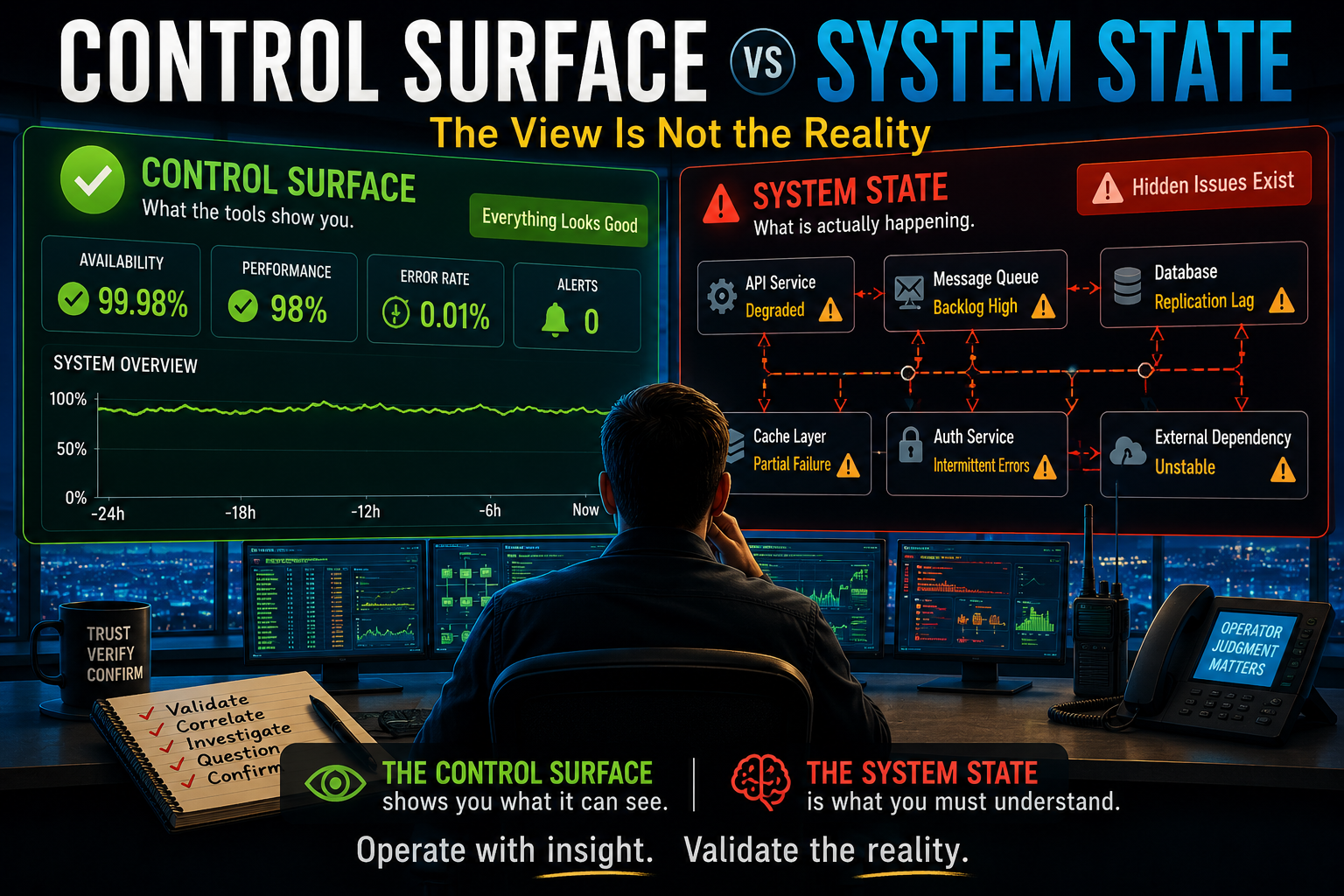
Every operational environment has a control surface.
Dashboards.
Monitoring screens.
Status pages.
Alert consoles.
Management tools.
Each one provides a view of what the system is doing.
These tools are essential.
They help teams detect problems, monitor performance, and make decisions.
The challenge is that the control surface is not the system.
It is a representation of the system.
It shows what the tools can observe, not necessarily everything that is happening.
The actual system state exists beyond the dashboard.
It includes components, dependencies, interactions, and conditions that may not be visible in real time.
When the control surface and the system state are aligned, operations become more predictable.
When they begin to diverge, risk increases.
A dashboard can report healthy services while a critical dependency is quietly failing.
Performance graphs can appear stable while latency steadily increases elsewhere.
An alert may never trigger because the condition being monitored is not the condition that is actually changing.
The control surface still looks normal.
The system does not.
This is one reason operational surprises occur.
Teams naturally trust the information in front of them.
They assume the data is current.
They assume the indicators are complete.
They assume the absence of alarms means the absence of problems.
Those assumptions are understandable.
They are not always correct.
Experienced operators learn to distinguish between what the tools report and what the system may actually be experiencing.
They validate.
They correlate.
They investigate.
They question unexpected behavior, even when the dashboards appear healthy.
They understand that monitoring provides visibility, not certainty.
The best operational decisions come from combining system information with operational judgment.
Control surfaces help you navigate.
System state tells you where you really are.
The most reliable teams understand both.
Because effective operations are not built on what the dashboard says.
They are built on understanding what the system is actually doing.