
Most people recognize failure when it occurs.
Systems stop functioning.
Services become unavailable.
Errors appear.
Users begin reporting problems.
The disruption is visible.
Recovery, however, is often harder to recognize accurately.
This is because the return of normal operations does not always mean the underlying problem has been resolved.
A system can appear healthy while important risks remain unchanged.
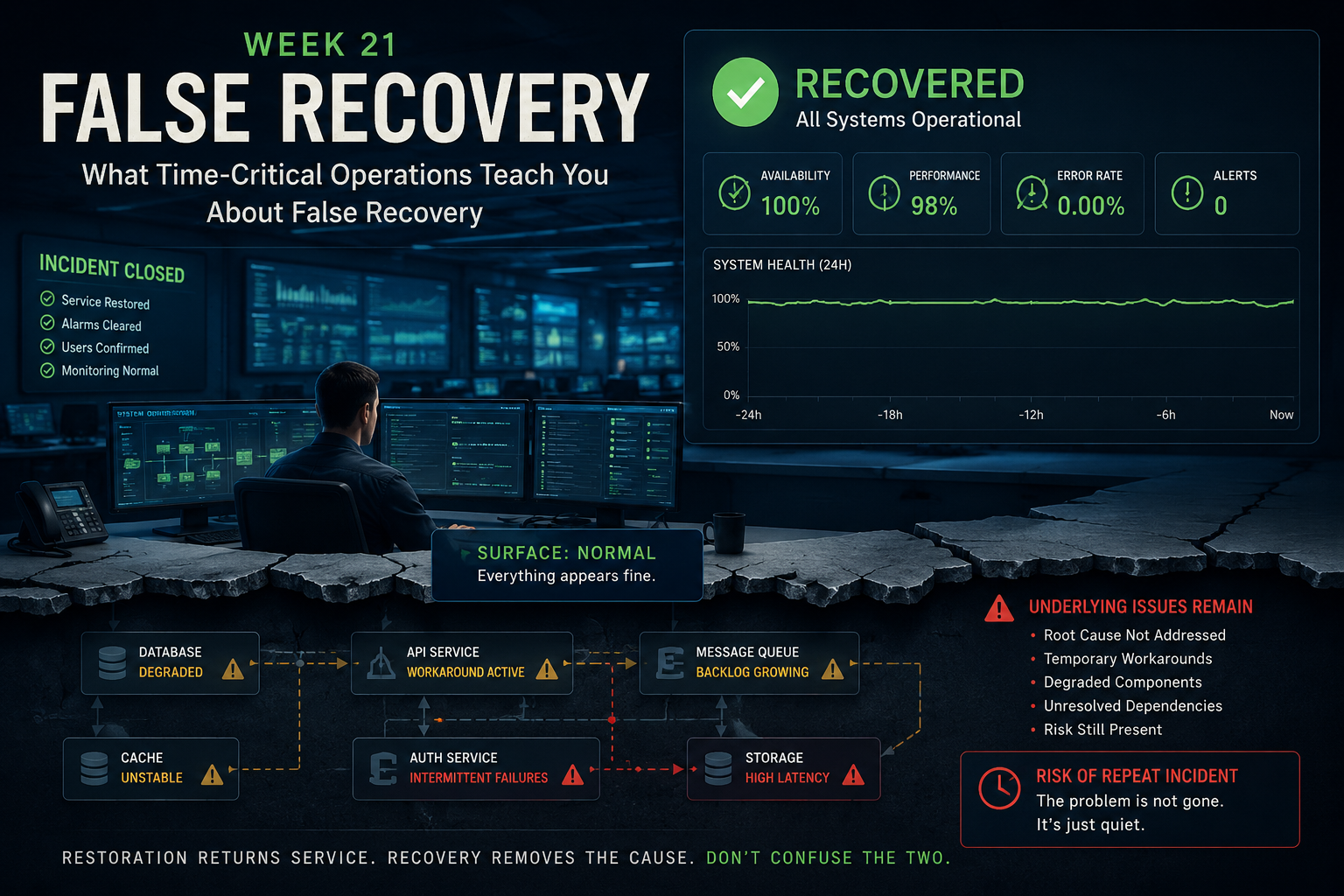
This creates what operators often experience as false recovery.
False recovery occurs when visible symptoms disappear, leading teams to believe a system has returned to a stable condition even though the factors that caused the disruption remain present.
The system responds.
Services return.
Alarms clear.
Performance improves.
Operational pressure begins to decrease.
From the outside, everything appears normal again.
The incident seems over.
In many cases, this is exactly when the greatest danger begins.
The restoration of service can create confidence.
That confidence can reduce urgency.
Investigation slows.
Validation becomes less rigorous.
Attention shifts to other priorities.
Meanwhile, unresolved conditions continue to exist beneath the surface.
A temporary workaround may have restored functionality.
A failed component may still be operating at reduced capacity.
A dependency may remain unstable.
A process weakness may remain unaddressed.
The visible problem disappears.
The underlying exposure does not.
This is one reason repeat incidents are often surprising to the people experiencing them.
The first disruption receives attention.
The second disruption creates confusion.
Teams frequently ask why the issue returned.
In reality, the issue may never have left.
Only the symptoms disappeared.
Experienced operators understand that recovery and restoration are not always the same thing.
Restoration means functionality has returned.
Recovery means the system has returned to a condition where the original failure is unlikely to occur again for the same reason.
Those are not identical outcomes.
The difference becomes especially important in time-critical environments.
Pressure naturally encourages teams to restore service as quickly as possible.
That objective is important.
But restoring service is only part of the work.
Reliability depends on understanding whether the conditions that created the incident have actually been removed.
Because systems do not become reliable when alarms stop.
They become reliable when the causes behind those alarms have been addressed.
And until that happens, recovery may be more apparent than real.