
Most people imagine operational failures as sudden events.
A system works.
Something breaks.
The failure occurs.
Reality is often far less dramatic.
Many systems do not fail suddenly.
They drift.
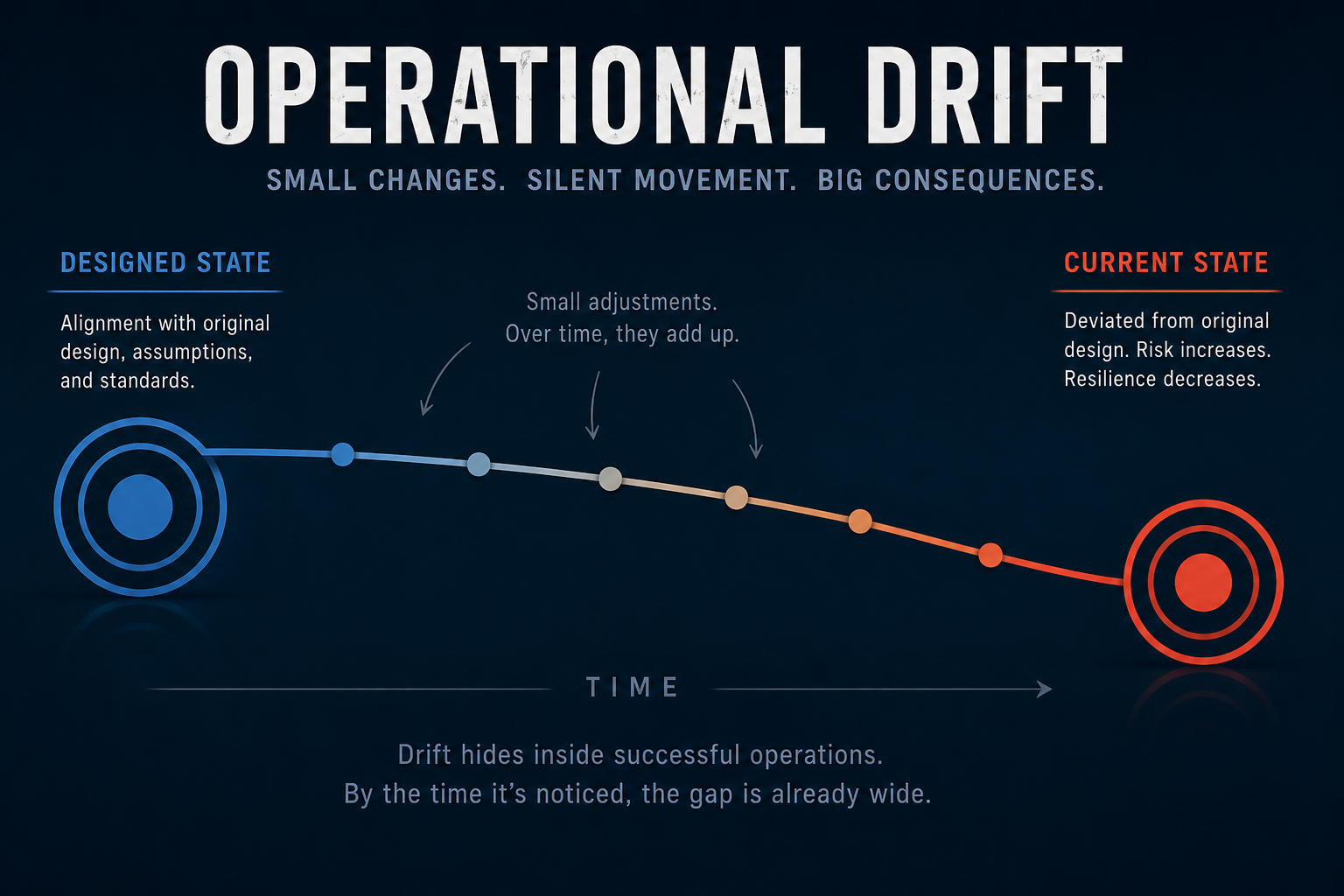
Operational drift occurs when a system gradually moves away from its original design, expectations, or operating assumptions without anyone fully recognizing the change while it is happening.
The movement is often small.
A workaround is introduced.
A process is modified.
A responsibility shifts.
A dependency changes.
Documentation falls behind reality.
An exception becomes routine.
None of these actions appear dangerous by themselves.
In fact, many of them are reasonable responses to real-world conditions.
The problem is not the individual adjustment.
The problem is accumulation.
Over time, small changes begin to interact with one another.
The system that exists today may look similar to the system that existed months or years ago.
But beneath the surface, important assumptions have changed.
Procedures may no longer match actual practice.
Documentation may no longer reflect operational reality.
Dependencies may have evolved without corresponding updates elsewhere.
The system continues functioning.
That continued success creates confidence.
And confidence often delays investigation.
This is one reason operational drift can remain invisible for long periods of time.
The system still appears stable.
Outputs still appear normal.
Incidents may remain infrequent.
Nothing obvious suggests that reliability is gradually eroding.
Yet the distance between designed state and actual state continues to grow.
When a disruption eventually occurs, teams often focus on the triggering event.
The outage.
The failure.
The missed action.
The visible symptom.
What they sometimes miss is that the conditions supporting the failure may have been developing for much longer.
The final incident simply revealed the accumulated drift.
This is why experienced operators pay attention to small deviations.
Not because every deviation creates risk.
But because repeated deviations can slowly reshape the operating environment.
And once drift becomes embedded in normal behavior, it becomes much harder to recognize.
Operational reliability is not only about responding to failures.
It is also about noticing movement before failure occurs.
Because systems do not always fail through disruption.
Sometimes they fail through gradual separation from the conditions that once made them reliable.