
Every system will eventually experience failure.
Hardware wears out.
Software contains defects.
Networks become unavailable.
People make mistakes.
No operational environment is immune.
The question is not whether disruption will occur.
The question is what happens next.
Many organizations invest heavily in preventing failure.
Far fewer invest the same effort in preparing for recovery.
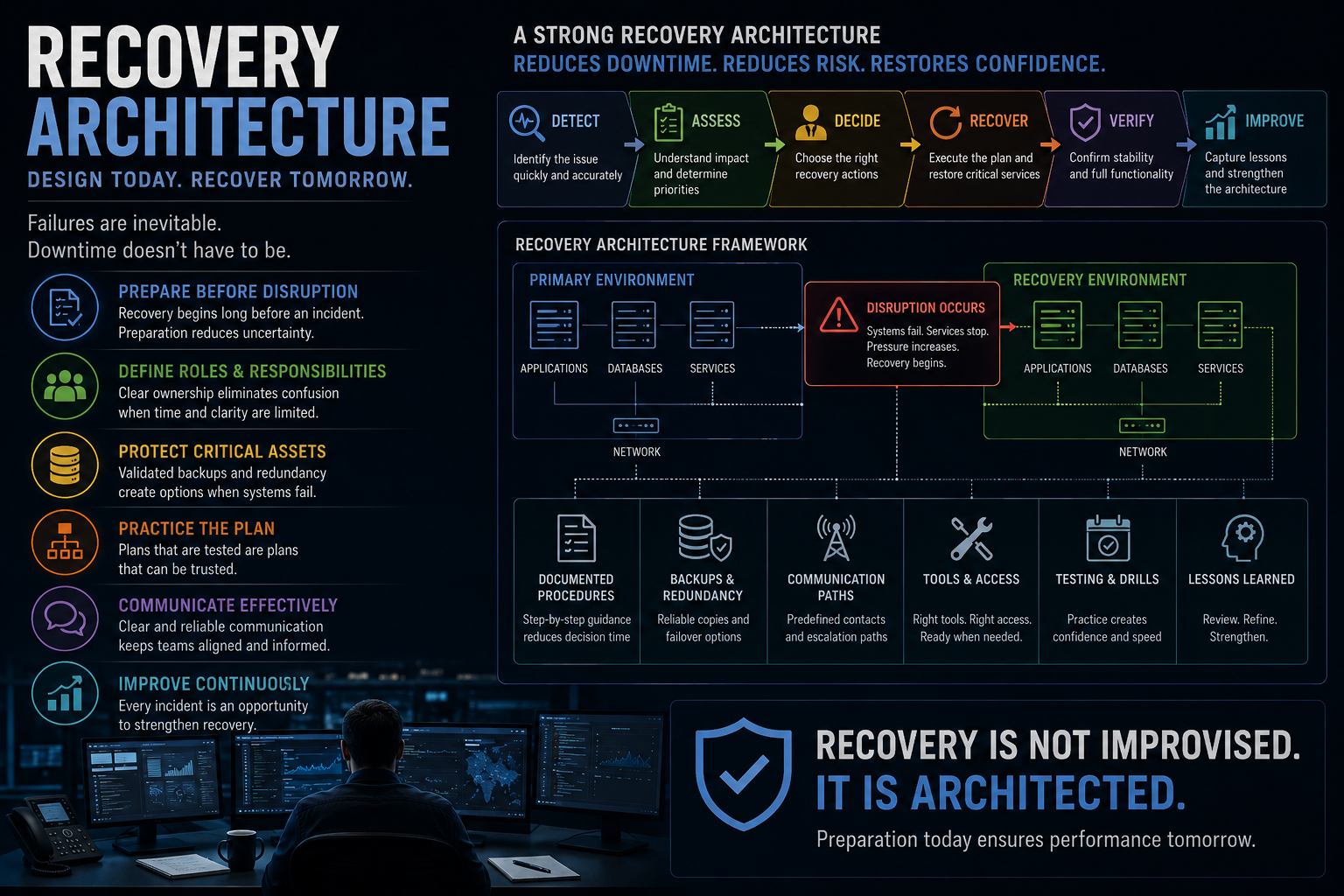
Recovery architecture is the deliberate design of systems, processes, and operational practices that allow services to be restored quickly, safely, and predictably after disruption occurs.
Recovery does not begin during an incident.
It begins long before one ever happens.
Clear procedures.
Documented responsibilities.
Validated backups.
Redundant systems.
Practiced response plans.
Defined communication paths.
Each one becomes part of the recovery architecture.
When these elements already exist, teams spend less time deciding what to do.
They spend more time executing.
Without preparation, every incident becomes a unique problem.
Teams search for documentation.
Ownership becomes uncertain.
Critical decisions are made under unnecessary pressure.
Recovery slows.
Risk increases.
Well-designed recovery architecture reduces uncertainty before uncertainty arrives.
It creates consistency during situations that are anything but consistent.
It allows experienced operators to focus their attention on the problem itself instead of debating the recovery process.
Perhaps the most valuable characteristic of recovery architecture is confidence.
Not confidence that failures will never occur.
Confidence that the organization can respond effectively when they do.
That confidence is earned through preparation.
It is strengthened through testing.
It is reinforced through continuous improvement after every incident.
Reliable operations are not built solely by preventing disruption.
They are built by ensuring that disruption does not become catastrophe.
Because operational excellence is measured not only by how well systems perform under normal conditions.
It is also measured by how well they recover when normal conditions no longer exist.