
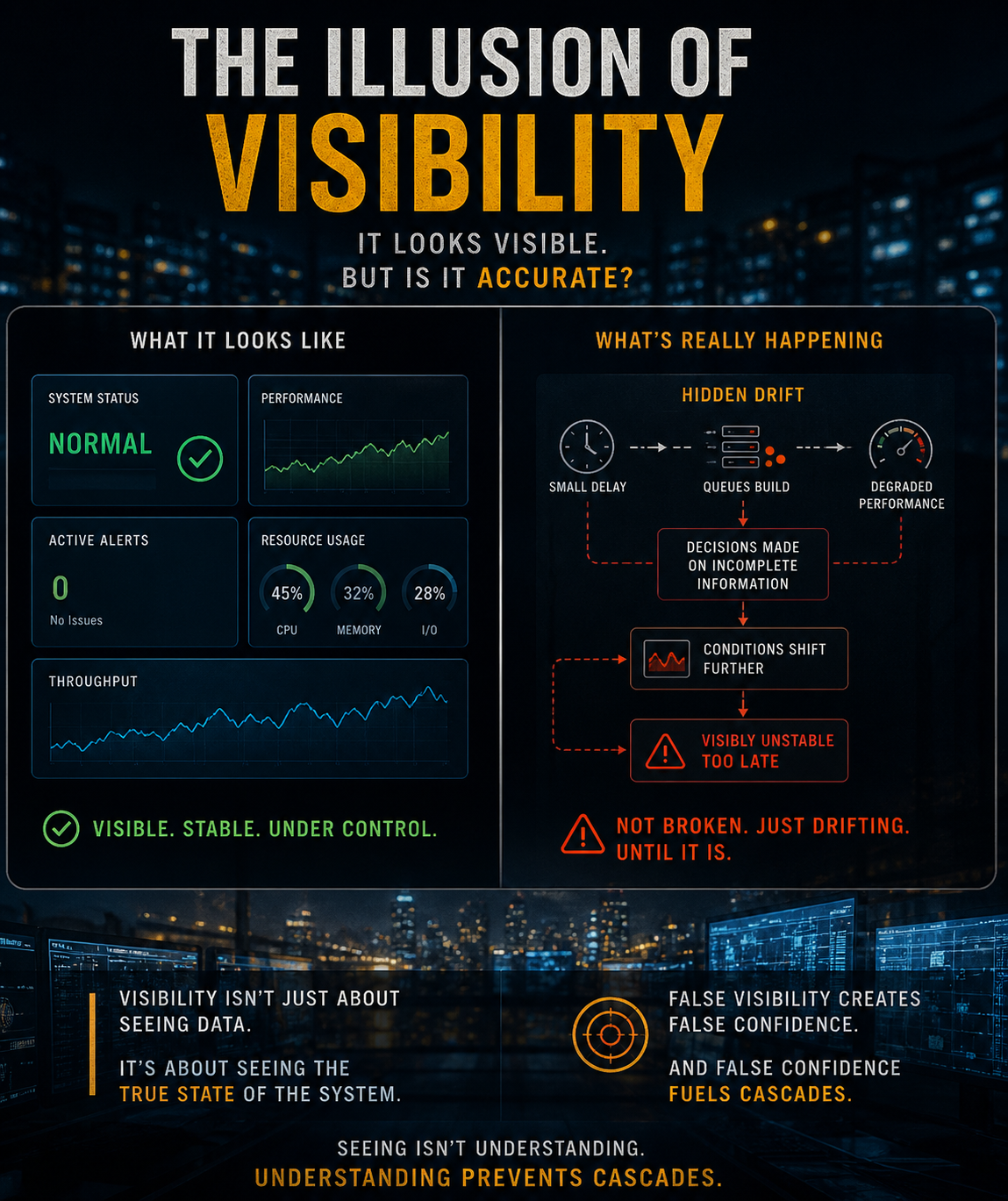
In time-critical systems, visibility isn’t always lost. Sometimes, it’s present—but misleading.
Information is available. Dashboards are active. Signals are coming through. From the outside, everything appears visible.
But visibility isn’t just about access to information. It’s about whether that information reflects the true state of the system.
In many operational environments, systems are monitored continuously. Metrics update. Alerts trigger. Interfaces show activity. And yet, decisions are still made with incomplete understanding.
Because what’s being seen isn’t the whole picture.
The system can appear stable while conditions are shifting underneath. Data can be accurate—but disconnected from what actually matters. Signals can be present—but interpreted without context.
This creates a form of false confidence. Operators believe they have visibility, but what they actually have is a partial view that looks complete.
At that point, decisions don’t stop. They continue—based on what appears to be clear.
And that’s where problems begin to move. Not because visibility is gone, but because it’s misleading.
A response is made. The system changes. But the impact of that change isn’t fully visible. So the next decision is made with the same incomplete picture.
And then another.
The system doesn’t break. It drifts.
This is where cascades often start. Not in darkness, but in environments where everything looks visible enough to act.
Because once decisions are based on a misread system, each step adds complexity that isn’t fully understood.
Clarity turns into assumption. Assumption turns into reaction.
And by the time the system becomes visibly unstable, the underlying conditions have already shifted beyond easy recovery.
Visibility wasn’t absent. It just wasn’t accurate.