
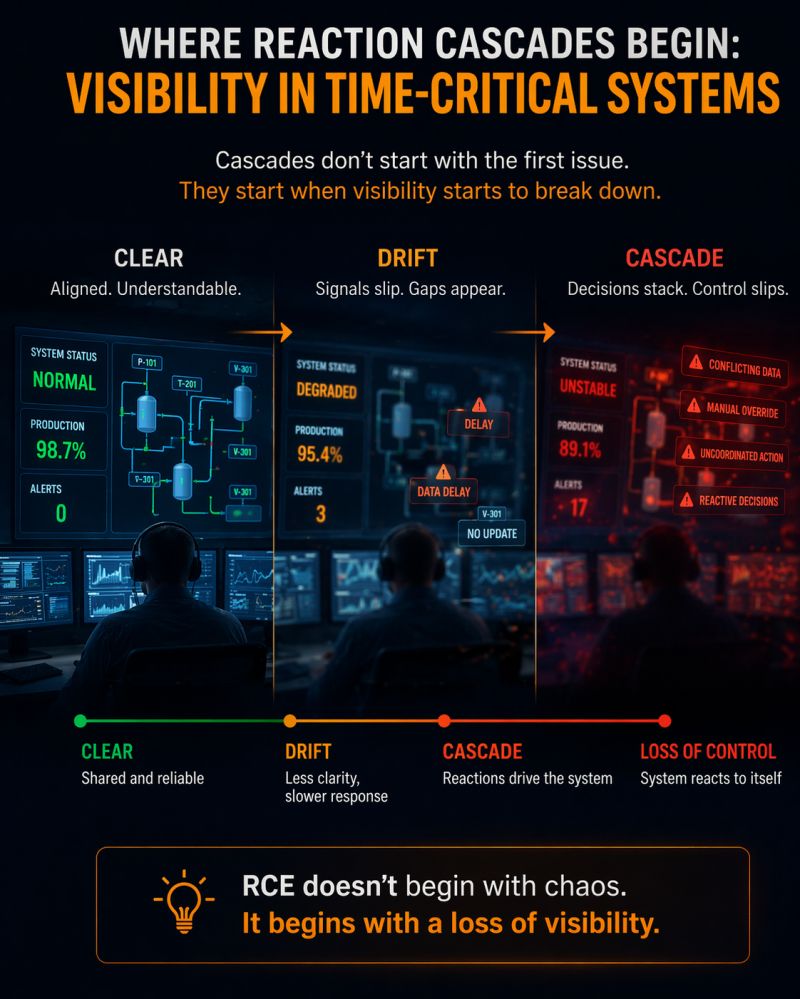
Reaction cascades don’t begin with the first issue. They begin when visibility starts to degrade.
In time-critical environments, decisions are made continuously. Each one depends on understanding what changed, what it affects, and what happens next.
When that visibility is clear, the system stabilizes. When it isn’t, something else happens.
A response is made—but its full impact isn’t visible. So another decision follows, based on partial information. Then another.
The system doesn’t break. It begins to drift.
At first, the signals are subtle: delayed data, missing context, conflicting inputs.
Individually, they seem manageable. Together, they change how decisions are made.
Clarity turns into estimation. Estimation turns into reaction.
This is where cascades begin.
Not at the moment something goes wrong—but at the moment the system can no longer clearly represent its own state.
From there, each action adds complexity: coordination becomes harder, outcomes become less predictable, and decisions start stacking on each other.
At a certain point, the system stops solving the problem.
It starts reacting to itself—or to the first visible symptom instead of the underlying condition. That’s where control is lost.
Reaction Cascade Effect isn’t just about how systems escalate. It’s about how they become harder to see clearly—step by step, decision by decision.
And once visibility is gone, recovery gets harder with each move.
SPONSORED BY: Legal Shield
Legal Shield & ID Shield
Protecting Families & Businesses Nationwide.
SPONSORED BY: The Piety Paychain
Helping to fund these pages.
Learn more about the Piety Paychain