
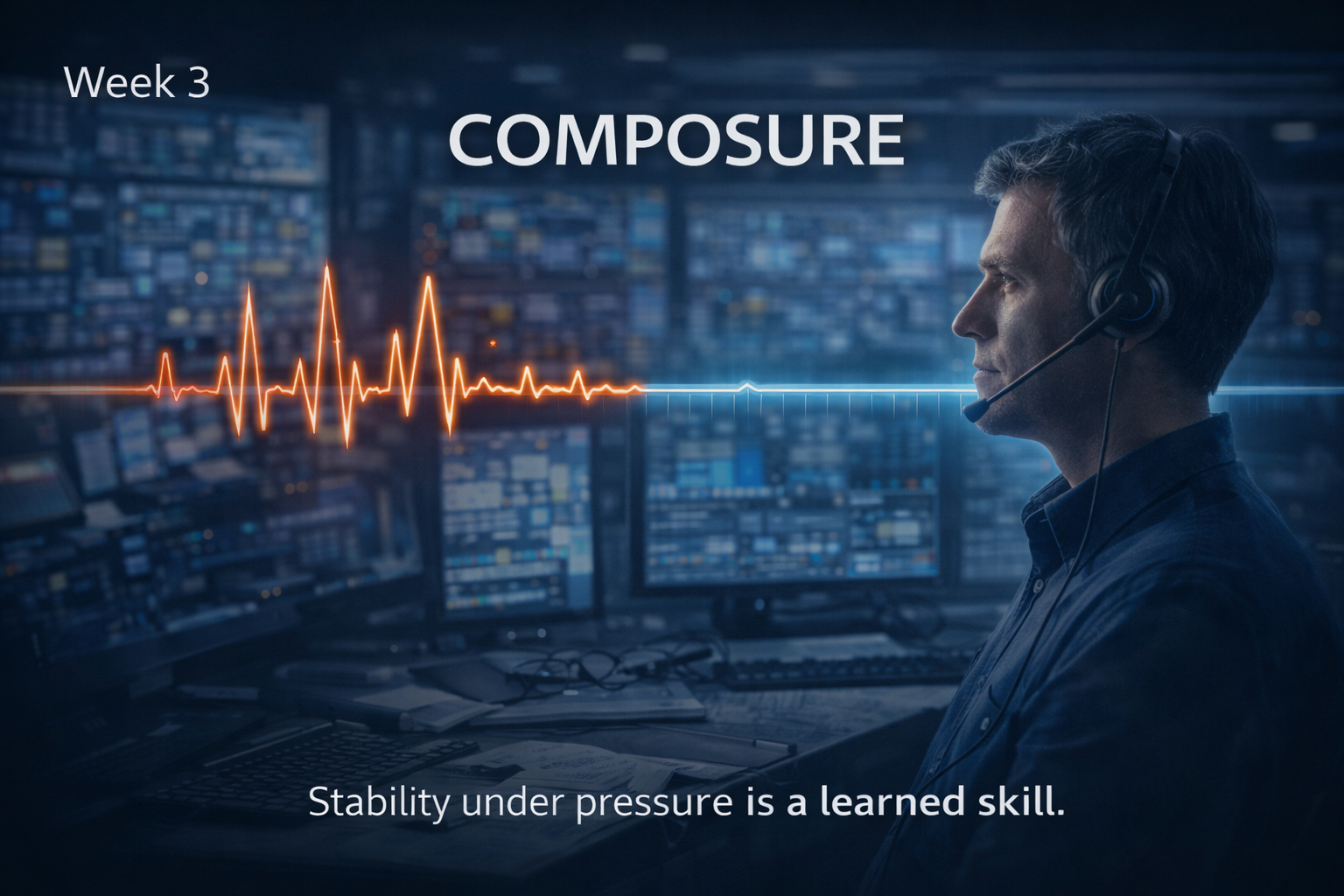
In 24/7 systems, pressure isn’t occasional — it’s constant, and often certain.
Deadlines don’t move.
Dependencies don’t pause.
The audience never sees the internal variables.
When something begins to drift off plan, the instinct is speed. React quickly. Correct visibly. Restore normal. But in complex environments, speed without clarity often creates secondary failures.
Experienced operators — inside stable systems — do something counterintuitive in those moments: they slow down.
They isolate variables before touching the system.
They confirm upstream assumptions.
They consider what the next action will affect downstream.
Because in time-critical operations, the real risk isn’t the initial disruption.
It’s compounding it.
Composure isn’t personality.
It’s trained restraint.
Over time, you develop structured thinking patterns — not scripts, but disciplined ways of assessing risk. You learn which issues require intervention and which require observation. Not every deviation is a crisis.
The calmest person in the room is rarely the least concerned.
They’re the most aware of consequences.
And that discipline is built through repetition, not adrenaline.
In high-stakes systems, clarity protects stability more than urgency ever will.