
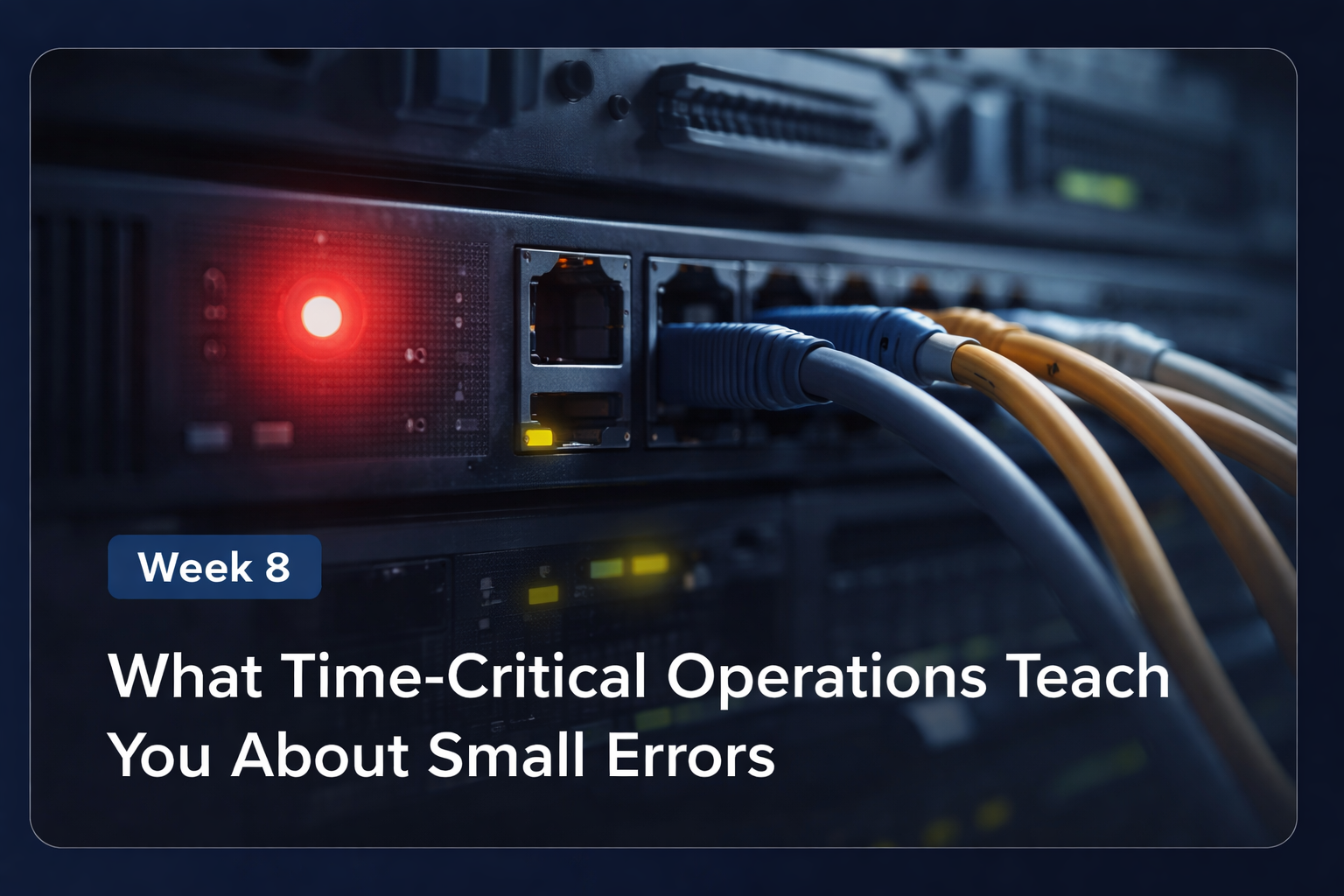
Most operational failures do not begin with dramatic breakdowns.
They begin with small errors.
A timing offset.
A misnamed asset.
A configuration detail that was assumed rather than verified.
Individually, these issues rarely appear serious. Systems often continue functioning despite them. Teams adjust, compensate, and move forward.
But in complex environments, small errors accumulate.
And accumulation changes system behavior.
In broadcast and streaming operations, the early signs of trouble are often subtle. A manual correction becomes routine. A workaround becomes normalized. A slight delay becomes accepted as “how the system works.”
Over time, these adjustments create operational drift.
Nothing appears broken.
Yet the system is slowly moving away from its intended design.
Reliable operations pay attention to these small signals long before they produce visible disruption.
Small errors reveal weak points in process discipline.
They show where documentation is unclear.
Where assumptions replaced verification.
Where responsibility for a step quietly shifted.
Left unaddressed, those weak points multiply.
And when pressure increases — during a live event, a system change, or a high-stakes transition — the accumulated drift becomes visible.
Not because the moment created the problem.
Because the moment revealed it.
Reliable systems treat small errors as signals.
A repeated timing discrepancy triggers review.
A recurring manual correction triggers redesign.
A persistent workaround triggers documentation updates.
Operational reliability depends on reducing the gap between the system that was designed and the system that actually exists.
Small errors expose that gap.
Reliability rarely fails all at once.
It erodes gradually.
That is why the most stable environments correct minor deviations early, before pressure exposes them.
Because the most dangerous failures rarely begin with major disruption.
They begin with small errors that were ignored for too long.